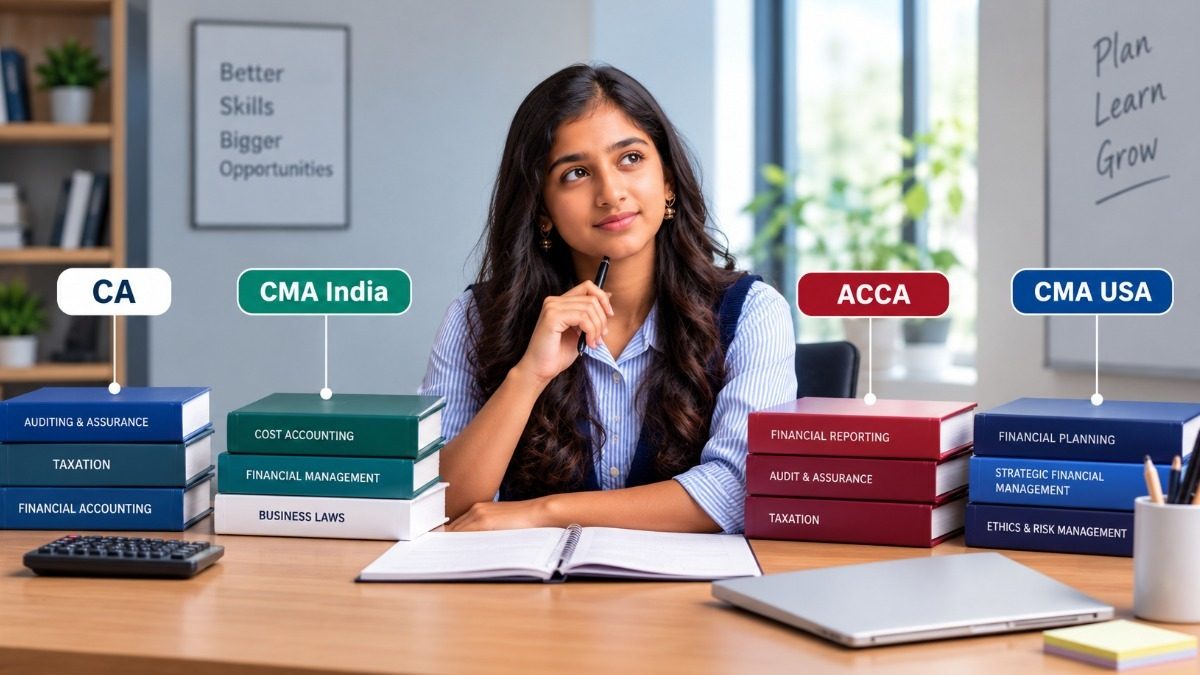

For many students, a B.Com degree and a professional qualification do not have to be separate choices. CA, CMA India and ACCA can all form part of a broader finance education plan, but the way you combine them with your degree depends on the course structure, eligibility requirements and how much study time you can realistically manage.
If you are considering a professional qualification alongside your degree, the important question is not simply whether it is possible. It is whether you can plan both pathways in a way that keeps your academic performance and professional preparation on track.
Can You Study CA, CMA or ACCA Alongside a Degree?
Yes. Students can pursue professional qualifications alongside their undergraduate degree, although the entry route and requirements differ between CA, CMA India and ACCA.
For CA, students in the final year of graduation can provisionally register for the Intermediate Course through the Direct Entry Route, subject to the prescribed graduation marks and study requirements. Graduates meeting the eligibility criteria can also register directly for Intermediate.
For CMA India, graduates of any discipline can register for the Intermediate Course, while students awaiting their final graduation result can also apply provisionally. This makes CMA India a practical option to plan alongside a degree.
ACCA is particularly flexible for students studying at university. In India and certain other markets, eligible students at ACCA-accredited universities may be able to take ACCA exams before graduation through conditional exemption arrangements.
The key is to understand the route before you register, rather than assuming all three qualifications work in exactly the same way.
CA Alongside a Degree: What Should Students Know?
CA has a structured progression through Foundation, Intermediate and Final. However, graduates and eligible final-year students can use the Direct Entry Route to enter Intermediate without taking the Foundation examination.
If you are still pursuing your degree, provisional registration for Intermediate is possible during the final year. You must subsequently complete graduation with the required marks and fulfil the prescribed study period before becoming eligible to appear for the Intermediate examination.
For students pursuing a B.Com, this can create a useful academic overlap. Subjects such as accounting, taxation, business law and financial management can support your CA preparation, although the professional syllabus requires more focused and detailed preparation.
The challenge is workload. CA preparation demands consistent study, so students need to plan their university assignments, examinations and CA preparation rather than treating the professional course as something to fit in whenever they have spare time.
CMA India Alongside a Degree: Is It Possible?
CMA India can also be pursued alongside a degree. Graduates of any discipline are eligible to register for the Intermediate Course, and students awaiting their final graduation results can apply provisionally.
For B.Com students, there can be useful academic overlap between the degree and CMA India. Areas such as financial accounting, cost accounting, financial management and business-related subjects can provide a foundation for professional study.
CMA India follows Foundation, Intermediate and Final stages. Students who enter through the graduate route can begin at Intermediate, making the combination with a degree particularly relevant for students who already know they want to build a career in accounting, cost management or finance.
The important consideration is not simply completing two qualifications at once. It is making sure that your study schedule leaves enough time for professional-level preparation.
ACCA Alongside a Degree: How Does It Work?
ACCA offers one of the more flexible routes for students who want to combine university study with professional accounting education.
Students studying eligible degree programmes at ACCA-accredited universities in India may have access to conditional exemptions, allowing them to progress with ACCA examinations before completing their degree. The exact exemptions depend on the university programme and the student’s academic background.
ACCA also awards exemptions based on relevant prior learning. Depending on the qualification, exemptions may be available from Applied Knowledge and Applied Skills examinations, while Strategic Professional examinations are not exempted. Students should use the official ACCA Exemptions Calculator to determine their individual position.
This flexibility can make ACCA attractive to students who want to build professional accounting knowledge while completing their degree, but it still requires disciplined planning.
Which Degree Works Best With a Professional Qualification?
A B.Com is a natural academic companion to CA, CMA India and ACCA because it provides a foundation in accounting, finance, economics and business.
However, students from other degree backgrounds may also be able to pursue these qualifications, depending on the relevant eligibility rules.
The bigger advantage of combining a degree with a professional qualification is the opportunity to connect academic concepts with professional-level applications. Instead of learning accounting only for university examinations, students can gradually understand how those concepts are used in auditing, financial reporting, management accounting, taxation and business decision-making.
How Do You Manage Two Study Commitments?
The biggest challenge is usually not eligibility. It is time management.
A degree already comes with lectures, assignments, internal assessments and university examinations. A professional qualification adds another layer of study, revision and examination preparation.
A practical approach is to create separate study schedules for university and professional exams. During normal academic weeks, maintain consistent progress in your professional subjects rather than leaving everything until examination season.
It is also important to understand your own capacity. Taking too many professional papers at once may not necessarily be the fastest route if it affects your degree performance or leaves you struggling to prepare properly.
What Are the Benefits of Starting Early?
Starting a professional qualification alongside your degree can help you build specialised knowledge before graduation.
By the time you complete your B.Com, you may already have progressed through part of your professional qualification, depending on the course and your examination progress. You also gain more time to develop technical knowledge in areas such as financial reporting, taxation, management accounting, audit, analysis and business finance.
There is another advantage: early exposure helps you understand which areas of finance actually interest you. That can make later career decisions more informed rather than based only on the title of a qualification.
How Should You Choose Between CA, CMA India and ACCA?
The right choice depends on the kind of finance career you want to build.
CA is a strong fit for students interested in auditing, taxation, financial reporting and professional accountancy within the Indian regulatory environment.
CMA India is suited to students interested in cost and management accounting, financial management, business strategy and related areas within the Indian professional environment.
ACCA can suit students looking for an internationally oriented accounting qualification, with a flexible examination structure and opportunities for exemptions based on prior learning.
Rather than asking which qualification is the easiest to combine with a degree, consider which one aligns with the type of work you eventually want to do.
Why Profinz Can Help You Plan Both Paths
Choosing a professional qualification while pursuing a degree requires a clear understanding of eligibility, course structure and study planning. Profinz offers CA, CMA India, CMA USA and ACCA, giving students the opportunity to explore different professional finance pathways before deciding where to specialise.
For students who are unsure whether to start a professional qualification during their degree or wait until graduation, academic guidance can help them assess the workload and choose a realistic route.
Profinz Branches Across Kerala
Profinz has campuses in Thrissur, Calicut, Kunnamkulam, Perinthalmanna and Malappuram, providing students across Kerala with access to professional finance education and academic guidance.
Whether you are beginning your B.Com, already midway through your degree or preparing for your final year, understanding how a professional qualification can fit into your academic plan can help you make better use of your time.
In Summary
Pursuing CA, CMA India or ACCA alongside a degree is possible, but each qualification has its own eligibility rules, structure and study requirements. CA and CMA India have specific routes that allow eligible students to progress towards professional examinations while completing their degree, while ACCA offers flexible study options and, for eligible students, conditional exemptions that can allow exams to be taken before graduation.
The key is to plan both commitments realistically. A professional qualification can add significant value to your degree, but only when the two are managed with a clear study schedule and a course choice that matches your career direction.
If you are considering starting CA, CMA India or ACCA during your degree, compare the eligibility requirements, examination structure and workload before choosing your route.