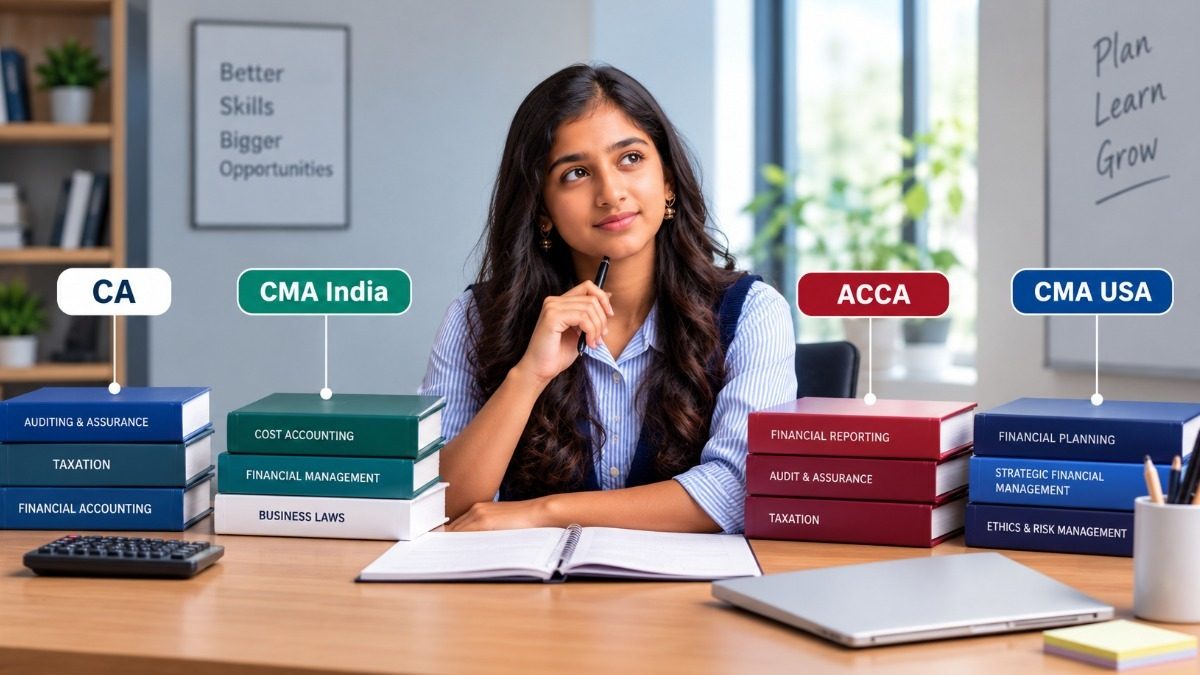

For B.Com graduates who want to build a career in finance beyond the Indian market, ACCA can provide a structured professional pathway with an international focus. The qualification covers financial accounting, management accounting, financial reporting, taxation, audit, financial management and strategic business skills.
A B.Com degree provides a broad academic foundation, while ACCA adds professional-level knowledge and practical experience. For students planning to work with multinational companies, global finance teams or international organisations, understanding how to use both qualifications together can help create a more focused career path.
What Is ACCA and Why Is It Relevant to Global Finance?
ACCA, or the Association of Chartered Certified Accountants, is a professional accountancy qualification with an international focus.
The qualification develops knowledge across financial and management accounting before progressing into areas such as taxation, financial reporting, audit and assurance, financial management and strategic business leadership. ACCA also includes an Ethics and Professional Skills Module and a Practical Experience Requirement.
This broad coverage can be useful for graduates who want to understand different areas of finance rather than specialising in only one accounting function.
Can You Start ACCA After B.Com?
Yes. B.Com graduates can pursue ACCA, and relevant prior learning may make them eligible for exemptions from some ACCA examinations.
ACCA assesses previous qualifications to determine whether they match the knowledge and skills covered by its exams. Depending on the qualification and subjects studied, exemptions may be available from some Applied Knowledge and Applied Skills exams. No exemptions are awarded from Strategic Professional exams.
The exact exemptions available depend on the student’s degree, institution, subjects studied and other relevant details. Students should therefore use ACCA’s official Exemptions Calculator rather than assuming that every B.Com graduate receives the same exemptions.
How Does B.Com Complement ACCA?
B.Com and ACCA can provide complementary forms of education.
A B.Com degree introduces students to accounting, finance, economics, business and related areas at undergraduate level. ACCA then develops professional knowledge across accounting and finance in greater depth.
This combination can help graduates connect academic concepts with professional applications.
For example, a student may encounter financial accounting during B.Com and then develop more advanced understanding through ACCA’s financial reporting studies. Similarly, knowledge of financial management can be developed further through ACCA’s professional-level finance subjects.
The value comes from using the two qualifications together rather than treating them as completely separate areas of study.
What Global Finance Areas Can ACCA Graduates Explore?
ACCA’s broad curriculum can support careers across several finance and accounting functions.
Graduates can explore areas such as:
- Financial accounting
- Management accounting
- Financial reporting
- Audit and assurance
- Taxation
- Financial management
- Financial analysis
- Corporate finance
- Business advisory
- Risk and compliance
The specific role a graduate enters will depend on their experience, technical skills, employer requirements and area of specialisation.
For students interested in international careers, this breadth can also make it possible to move between different finance functions as their experience develops.
Can ACCA Help You Work With Multinational Companies?
ACCA can be relevant to students targeting multinational companies and internationally oriented finance teams.
Global organisations often operate across different markets and require finance professionals who understand financial reporting, business performance, risk, financial management and professional standards.
ACCA’s international orientation and broad accountancy curriculum can provide a foundation for working in these environments.
However, an international qualification alone does not guarantee a global job. Students also need relevant experience, strong communication skills, digital capability and an understanding of the specific market in which they want to work.
Why Practical Experience Matters
Professional finance careers involve more than passing examinations.
ACCA’s Practical Experience Requirement requires students to gain relevant practical experience as part of the journey towards membership. Experience can be gained before, during or after completing the examinations and ethics components.
For a B.Com graduate, this means it can be useful to look for relevant finance or accounting experience while studying ACCA.
An internship, accounting role or finance position can help students understand how concepts from their studies are applied in real organisations while also building workplace skills.
What Skills Should You Build Alongside ACCA?
Professional knowledge is only one part of preparing for a global finance career.
B.Com graduates studying ACCA should also consider developing:
- Advanced Excel and financial modelling
- Data analysis and interpretation
- Financial reporting skills
- Business communication
- Presentation skills
- Digital and AI literacy
- Problem-solving
- Commercial awareness
- Cross-functional collaboration
These skills can help graduates move beyond simply preparing financial information and towards understanding what the information means for a business.
Does ACCA Help With International Career Mobility?
ACCA’s international focus can be useful for graduates who want to explore finance careers across different markets.
The qualification is designed for professional accountants working in a global environment, and ACCA provides examination opportunities across a wide international network. Its membership pathway also combines examinations, ethics and practical experience.
However, professional requirements can vary between countries. Certain roles, particularly regulated or statutory positions, may require local qualifications, registration or additional requirements.
Students planning to work in a specific country should therefore research the professional and regulatory requirements of that market before making career decisions.
What Should You Do After B.Com to Build a Global Finance Career?
Completing B.Com is only the beginning. Students can use the next stage of their career to combine professional qualification with practical experience.
A useful approach is to:
- Check your ACCA exemptions
- Create a realistic examination plan
- Build strong financial and analytical skills
- Gain relevant work experience
- Improve Excel and digital finance skills
- Develop professional communication
- Follow developments in global business and finance
- Research the market where you want to work
This creates a more complete profile than relying on a qualification alone.
Why Profinz Can Help B.Com Graduates Pursue ACCA
Profinz offers ACCA as part of its professional finance education, helping students build their accounting and finance knowledge through structured academic preparation.
For B.Com graduates, pursuing ACCA can provide an opportunity to build on their existing commerce education while developing professional knowledge relevant to different areas of finance.
Combining professional studies with practical exposure and workplace-ready skills can help students prepare for the demands of an increasingly interconnected finance industry.
Profinz Branches Across Kerala
Profinz operates campuses in Thrissur, Calicut, Kunnamkulam, Perinthalmanna and Malappuram, giving students across Kerala access to professional finance education.
B.Com graduates can explore ACCA based on their academic background, available exemptions and intended career direction while building the skills required for finance roles in India and international markets.
In Summary
For B.Com graduates interested in global finance, ACCA can provide a professional pathway that builds on an existing foundation in commerce and accounting.
Its broad curriculum covers financial reporting, management accounting, taxation, audit, financial management and strategic business skills, while its practical experience requirement connects professional study with workplace exposure.
However, building a global finance career requires more than completing ACCA. Students should combine the qualification with practical experience, digital and analytical skills, communication ability and an understanding of the market in which they want to work.
For B.Com graduates planning their next step, ACCA can therefore be considered not simply as another qualification, but as part of a wider plan to build a career in professional and international finance.